Part of our guide: How to start a car rental business (without quitting Turo)
Turo’s protection plan covers the trip. Your car spends most of its life between trips: parked, at the car wash, on the way to the mechanic or to a guest. Whatever covers it then is your job, and the answer changes again the day you take a booking outside Turo.
Here’s what covers a Turo car in each situation, how Turo’s two off-trip insurance partners compare, and the questions to ask any insurer before you sign.
TL;DR
- Turo’s plan applies only during a reservation. Between trips, your car needs its own policy.
- Turo itself warns that many personal auto policies exclude car sharing. Don’t assume yours covers a car you list.
- Off-trip insurance from Turo’s partners Tint (3+ cars) and INSHUR (1+ car) covers cars between trips, from roughly $34 to $82 per car per month.
- Off-trip plans don’t cover direct bookings or other platforms. If you rent outside Turo, you need a commercial rental policy.
- Whatever you buy, ask which periods it covers, who can drive, and whether the carrier is admitted or surplus lines.
The four situations a Turo car is in
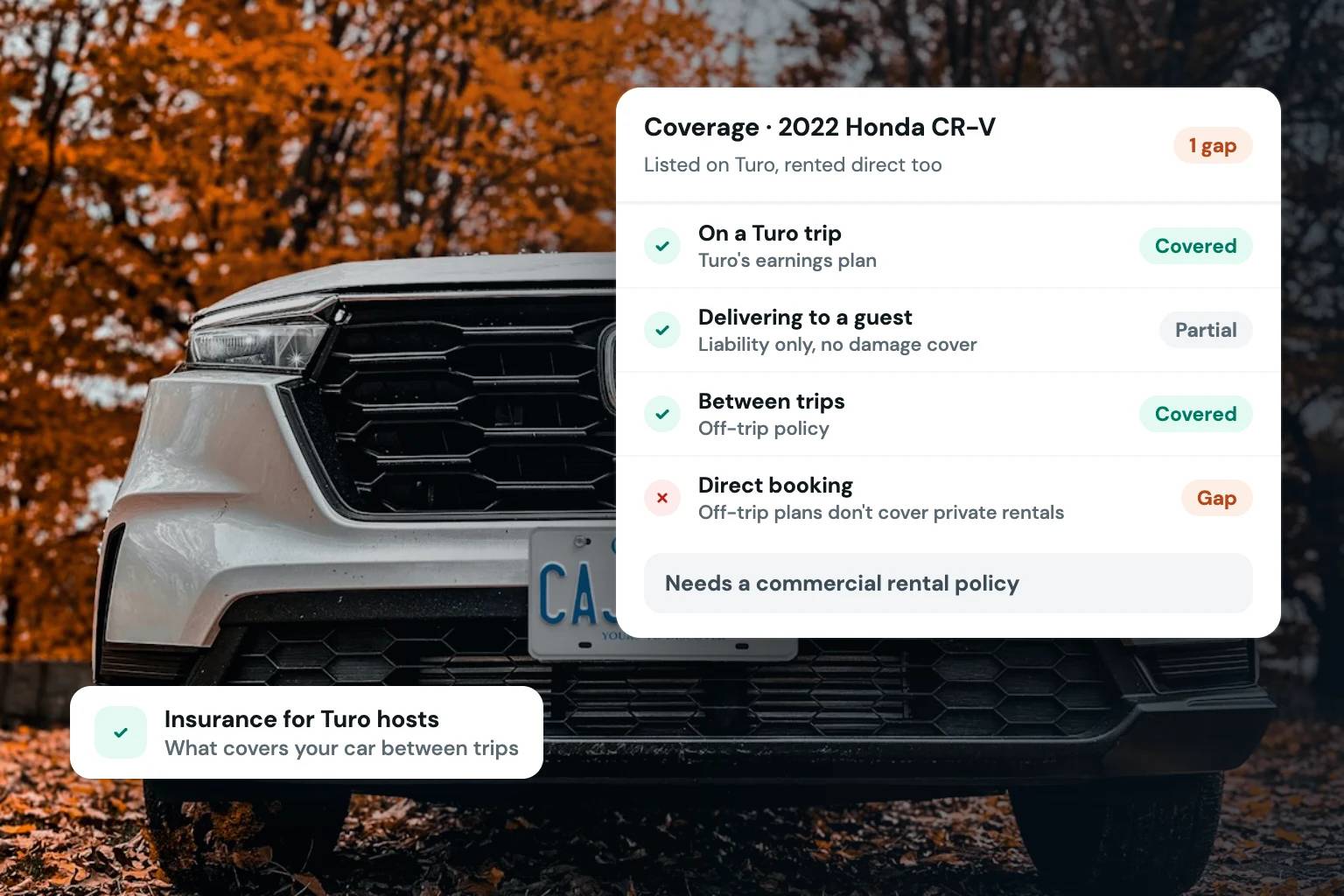
Coverage follows what the car is doing, not who owns it. This is how the pieces fit together for a US host:
| When | What covers it | Watch for |
|---|---|---|
| On a Turo trip | Turo’s earnings plan: third-party liability insurance plus physical damage reimbursement for your car | Damage responsibility, exclusions and the photo rules. Our direct-rentals insurance guide breaks the plans down. |
| Delivering a car to a guest | Liability under Turo’s plan, only if the guest booked delivery | No reimbursement for damage to your car while you deliver it, and the drive back after the trip isn’t included. |
| Between trips | Your own policy: personal, off-trip, or a commercial fleet policy | Personal policies often exclude cars used for car sharing. This is the gap off-trip plans fill. |
| Direct bookings and other platforms | Your own commercial rental policy, plus anything the renter brings | Turo’s plan and Turo’s off-trip partners don’t apply here at all. |
The delivery row catches people out. Turo’s earnings plan terms give you liability coverage while you deliver a car to a guest who booked delivery, but no reimbursement if your car is damaged on the way, and the drive back after the trip isn’t part of the delivery period at all. Your own policy has to cover those miles.
Why your personal policy is a risk
Personal auto insurance is written for you driving your own car. Turo’s own terms say it plainly: “Many private passenger automobile insurance policies exclude coverage for peer-to-peer car sharing.” That’s about the trip itself, where Turo’s plan takes over. The bigger question is what happens between trips.
Some insurers keep covering a car between Turo trips. Others treat listing it as business use, and a claim on a car they learn is on Turo can turn into a denied claim or a non-renewal. Turo also leans on your policy in one place you might not expect: for flood, hail and other acts of nature during a trip, its terms exclude costs your own primary insurer wouldn’t have paid.
If your Turo cars are on a personal policy today, call your insurer, tell them the car is on Turo, and get their answer in writing.
Off-trip insurance: Tint vs INSHUR
Turo partners with two companies for off-trip cover, a commercial policy for the time your cars aren’t booked. Both can be written in your business’s name, both meet state minimums where they’re sold, and both cover only the host, co-hosts and employees as drivers. The differences are below, all taken from Turo’s off-trip insurance page as of November 4, 2026:
| INSHUR | Tint | |
|---|---|---|
| Minimum fleet | 1 car | 3 or more cars on Turo at all times |
| Where | 26 states | Every state except New York and Kentucky |
| Starting price, liability only | $40 per car per month | $34 per car per month |
| Starting price, damage and liability | $82 per car per month | $54 per car per month |
| Deductibles | $2,500 under $50k value, $5,000 at $50k+ | $1,000, $2,500, or $5,000 for cars worth $50k+ |
| GPS tracker | Required within 60 days (Bouncie, MooveTrax, Zubie and others) | Optional; without one you move to a pricier plan after 60 days |
| Personal driving | Up to 50% of off-trip miles | Not covered (business use only) |
| Mileage | Up to 250 business miles a month | Unlimited off-trip miles |
| Fleet discounts | Tiers at 4+ and 10+ cars | Priority service at 40+ cars with 25+ covered |
In short, INSHUR fits a host with one or two cars who still drives them personally sometimes. Tint fits a fleet of three or more cars used only for business, especially one that puts on a lot of off-trip miles. Turo’s page quotes slightly different starting prices in different places, so treat these as a floor and get a real quote. Both are sold through surplus lines carriers in at least some states, which Turo’s page notes means a claim may not be paid if the carrier becomes insolvent.
The catch: Turo’s FAQ says Tint and INSHUR off-trip insurance “only apply to vehicles listed on Turo and don’t cover use on other platforms or for private rentals.” If a car is on Getaround too, or you rent it to a repeat guest directly, an off-trip policy won’t cover that rental.
When you rent outside Turo
Most hosts who grow past a few cars start taking some bookings directly: repeat guests, local businesses, insurance replacements, longer rentals. None of Turo’s coverage follows those bookings, and neither do Turo’s off-trip partners.
What replaces it is a commercial rental policy written for a rental fleet. Many of them cover the same cars on Turo trips and on bookings you take yourself, which is what you want if you run both. Some hosts also require renters to bring their own auto policy, or sell coverage at checkout. Our guide to insurance for direct rentals covers each layer and what it costs compared to Turo’s cut.
How to choose
- One or two cars, Turo only. Ask your current insurer whether it covers the car between trips, in writing. If not, INSHUR is the off-trip option for small fleets.
- Three or more cars, Turo only. Compare Tint and INSHUR quotes against a commercial fleet policy. Your miles, personal use and state decide it.
- Turo plus direct bookings, or planning to. Get quotes on a commercial rental policy that covers both. An off-trip plan alone leaves your direct rentals uninsured.
- Renting to gig drivers. Ask about rideshare and delivery use first. It’s the most common exclusion in rental fleet policies.
Questions to ask any insurer
- Which periods does this cover? Get it in writing for each one: between trips, delivery, the drive back after a trip, Turo trips, and bookings you take yourself.
- Does it cover cars I rent outside Turo? Turo’s off-trip partners say no. If you take or plan to take direct bookings, you need a policy that says yes.
- Who can drive? Off-trip plans cover the host, co-hosts and employees. A cleaner or friend moving the car may not be.
- Is the carrier admitted or surplus lines? Surplus lines carriers aren’t backed by state guaranty funds, so a claim may not be paid if the carrier fails. Turo’s page says this for both partners.
- Who handles claims, and how fast? Ask for a named claims contact and a typical turnaround. A car in the shop isn’t earning.
- Can the policy be in my LLC’s name? Both of Turo’s off-trip partners allow it. Match the policy, the registration and your Turo account.
- What are the vehicle value and age limits? Exotics and older cars are where policies get picky. Ask before you buy the car.
- Is gig or rideshare use excluded? Most rental fleet policies exclude renters driving for Uber, Lyft or delivery apps. If you rent to gig drivers, ask for that specific use to be covered.
- What telematics do you require? Find out which trackers count before you buy hardware for the whole fleet.
Where Fleetwire fits
Fleetwire doesn’t sell insurance, and it isn’t affiliated with Turo, Tint or INSHUR. It’s the booking software for the rentals you take yourself, and it makes your coverage hold up on every one of them. Renters can verify their own insurance in checkout, checked with their insurer rather than from a photo of a card. ID verification confirms every driver, deposits hold your deductible on the renter’s card, and the agreement is signed before pickup.
If your insurer wants GPS, Fleetwire connects with Bouncie and MooveTrax, both on INSHUR’s approved tracker list. Turo trips stay on the same calendar, so you can add direct bookings one car at a time. To see what Turo keeps from each trip today, try the Turo fee calculator.
FAQ
Do Turo hosts need their own insurance?
Yes. Turo’s listing requirements say hosts need valid car insurance, and Turo’s plan only applies during a reservation. Between trips, the car needs coverage of its own, and your state requires at least liability insurance on any registered car.
Does my personal car insurance cover Turo?
Usually not during a trip. Turo’s own earnings plan page notes that many personal auto policies exclude peer-to-peer car sharing. Between trips, some personal policies still cover the car and some cancel or refuse to renew once they learn it’s on Turo. Ask your insurer directly and get the answer in writing.
What is off-trip insurance for Turo?
A commercial policy that covers your Turo cars when they’re not on a trip, such as driving to the mechanic, the car wash or a delivery. Turo partners with Tint and INSHUR for it. Both meet state minimums where they’re offered.
Does Tint or INSHUR cover my direct bookings?
No. Turo’s off-trip FAQ says both “only apply to vehicles listed on Turo and don’t cover use on other platforms or for private rentals.” For bookings you take yourself, you need a commercial rental policy.
Is Turo’s protection plan insurance?
Partly. The liability part is a real insurance policy issued to Turo. The damage part for your own car is a contractual reimbursement from Turo, not insurance, and it follows Turo’s rules on photos, repair shops and exclusions.
How much is insurance for a Turo car?
Off-trip plans from Turo’s partners start around $34 to $82 per car per month, depending on the partner and whether you add damage cover, according to Turo’s page on 2026-11-04. Your real price depends on your state, cars and claims history.
Sources
- Turo: Off-trip insurance from Tint and INSHUR, including its FAQ (checked November 4, 2026)
- Turo: Earnings plans, in detail, US hosts (updated August 18, 2026)
- Turo: Listing a vehicle, US
- INSHUR: Off-trip car share insurance for Turo hosts
This article is general information, not insurance or legal advice. Coverage, prices and eligibility change, and they vary by state. The figures above are as published on the dates listed. Fleetwire doesn’t sell insurance and isn’t affiliated with Turo, Tint or INSHUR.